The PPWR Reality from a Converter’s standpoint
Published on June 9, 2026
Why PPWR Recyclable Mono-Material Packaging Isn’t as Simple as It Sounds?
Your brand owner just sent the mandate: “All packaging must be mono-material and recyclable by 2027. No exceptions.”
Your procurement team looked at the options. Your current multi-layer structures deliver perfect barrier, strength, and runnability. The mono-material alternatives? They barely work.
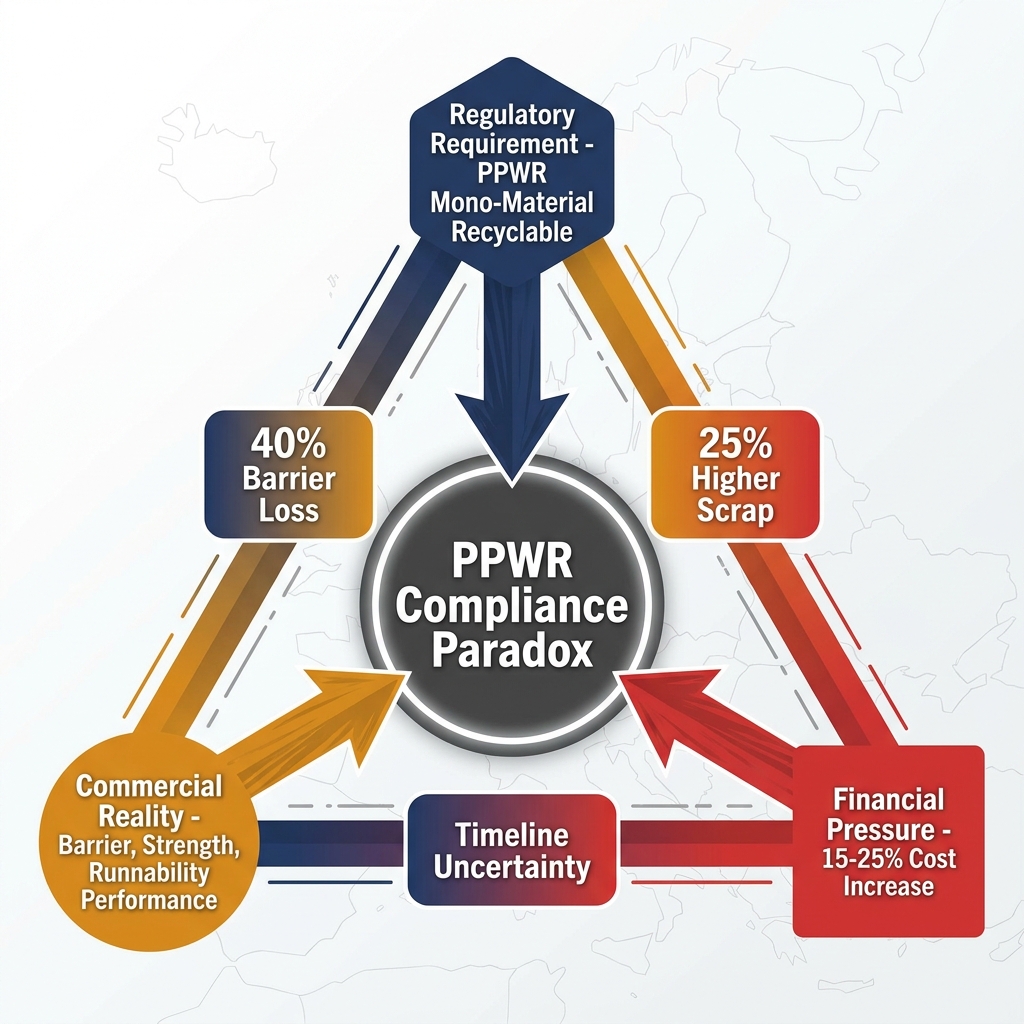
Welcome to the PPWR paradox: regulators want recyclability. Your customers want performance. Your costs are rising. And nobody’s sure how individual EU countries will actually enforce the rules.
The mono-material trap: Recyclable ≠ Runnable
Interpack 2026 made one thing clear: European converters are caught between two incompatible demands.
Regulatory requirement: Mono-material, fully recyclable structures by 2027 under PPWR.
Commercial reality: Mono-material PE and PP structures can’t match the barrier, strength, and runnability of proven multi-layer films.
What procurement teams are discovering:
Barrier performance gap: Your current PET/Metallized/PE structure delivers oxygen transmission <0.5 cc/100 sq in/day. Your mono-material PP alternative? 2-3 cc/100 sq in/day. Not close for perishable applications.
Strength and seal consistency: Multi-layer films deliver predictable performance. Mono-material films? Processors report 15-30% seal quality variation depending on line speed, temperature, and material batch.
Runnability on existing equipment: Your converting lines were designed for specific film properties. Switch to mono-material and you’re troubleshooting web breaks, seal failures, and downtime while PPWR deadlines approach.
You have 18-24 months to solve technical problems suppliers have been working on for 3+ years—without major capital investment.
PCR integration: The consistency nightmare
PPWR increasingly mandates recycled content alongside mono-material requirements.
What procurement teams experience with PCR:
Batch-to-batch variability: Virgin PE has consistent properties. PCR does not. Different recycling streams, different age and degradation profiles create variability your processes weren’t designed for.
Processing issues: According to Association of Plastic Recyclers guidelines, PCR materials have higher melt viscosity variability, moisture sensitivity, and contamination risk. Processors report 10-15% increase in scrap rates switching to PCR-containing formulations.
Quality impact: Clarity, color, and mechanical properties vary more with PCR. Customers notice. Brand owners complain.
One European converter: “PCR sounds good on a sustainability report. In reality, we’re spending 2-3x more on quality control and scrap management. The cost-benefit calculation doesn’t work yet.”
Cost pressure vs sustainability targets: The squeeze
European converters are caught between two economic forces:
From above: Brand owners demanding faster PPWR compliance. “Move your packaging to mono-material recyclable now.”
From below: Mono-material costs 15-25% more than multi-layer alternatives. Higher scrap rates. Converting costs rising. Equipment modifications adding capital investment.
Procurement teams report conversations like this:
Converter: “Mono-material PP costs 18% more, has 25% higher scrap, delivers 40% lower barrier.”
Brand owner: “Figure it out. Competitors are already moving.”
Converter reality: Competitors are either absorbing costs or haven’t actually validated performance yet.
PPWR uncertainty: The enforcement question
What makes PPWR uniquely difficult:
PPWR is a regulation framework where individual EU countries have interpretation latitude. What “fully recyclable” means in Germany might differ from France or Poland. What gets enforced aggressively in one country might be loosely monitored in another.
Procurement uncertainty includes:
- Timeline clarity: Different EU countries signaling different phase-in timelines
- Definition enforcement: How strictly will “mono-material” be interpreted?
- PCR mandates: Which countries? Which product categories? When?
- Enforcement mechanisms: Brand owner liability, converter liability, or material supplier liability?
This uncertainty affects decisions today. Do you invest in mono-material capability now when regulations might still change?
The shift: From transactional to strategic
European procurement teams recognize a fundamental shift in what they need from material suppliers.
Old model (price-driven):
- “Give me the best price for BOPP”
- Cost per kilo drives decisions
New model (partnership-driven):
- “Help me solve the mono-material vs performance paradox”
- Technical support on application optimization
- Guidance on PCR integration without destroying quality
- Supply chain flexibility to test alternatives quickly
One UK converter stated it directly: “We don’t need another BOPP supplier. We need a partner who understands our converting lines, our customer requirements, and our regulatory constraints—and can help us navigate all three.”
What European procurement teams need now
Action 1: Define PPWR-compliant structures by application.
Only PPWR mono-material recyclable packaging? Not all packaging needs mono-material. High-barrier applications may get exemptions. Dry goods might transition easily. Perishables? Most converters haven’t solved this yet.
Action 2: Test PCR integration realistically
Work with suppliers offering realistic 10-25% PCR content blends and validate scrap rates and performance variability on YOUR converting lines.
Action 3: Shift supplier conversations
Stop asking “who’s cheapest?” Start asking “who can help us solve this technical challenge within our timeline and cost constraints?”
Action 4: Communicate transparently with brand owners
“Fully recyclable by 2027” sounds good. “Mono-material with 15% higher costs, 25% higher scrap, and 40% lower barrier” is the reality.
Now Plastics positioning for European converters
The PPWR landscape requires more than material supply. It requires partnership.
We work with European converters across multiple polymers and converting technologies. We understand:
- Technical reality: Which mono-material structures work on existing lines. Which require compromise.
- Commercial reality: The cost pressure converters face and timeline constraints customers impose.
- Regulatory reality: How different EU countries interpret PPWR and where flexibility exists.
- Supply flexibility: Access to multiple material sources (virgin, PCR-blended, mono-material alternatives) from different geographies.
The converters succeeding with PPWR aren’t chasing newest materials. They’re building partnerships with suppliers who understand their specific constraints and offer solutions—not just materials.
👉 Now Plastics partners with European converters on PPWR compliance by combining technical application support, multi-source material flexibility, and strategic collaboration. We help you solve the mono-material vs performance paradox, navigate PCR integration without destroying quality, and manage the commercial pressure vs sustainability squeeze. Contact us.
PPWR compliance for European converter procurement teams. For supply chain resilience strategies, see our series on tariff monitoring, geographic diversification, safety stock strategy, and material substitution.