Beyond Just-in-Time: Safety Stock Strategy for the New Era of Disruption
Published on May 7, 2026
2019: Your 30-day inventory strategy worked fine. Lead times were predictable. Disruptions were rare.
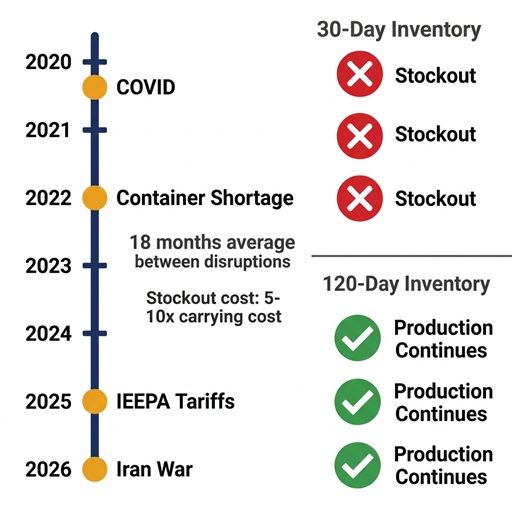
2026: In the past 6 years, you’ve faced COVID shutdowns, as much as $27,000 container costs, IEEPA tariffs, and the Strait of Hormuz closure.
The companies that are surviving didn’t just react faster. They held 3-4 months of safety stock and had time to adjust supply options while competitors shut down production lines.
The shift: Rare disruptions to constant volatility
Pre-COVID reality (1995-2019): Global supply chains operated with 25+ years of relative stability. Occasional disruptions happened but were isolated events with 3-5 year gaps between major incidents.
Just-in-time inventory worked. Lead times were predictable. Container costs were stable. Converters optimized working capital by minimizing inventory.
Post-COVID reality (2020-2026): Six years. Four major global disruptions.
2020-2021: COVID/Plant Shutdowns – Lead times doubled overnight. Converters with 30-day inventory ran out within 45 days.
2022: Container Shortage Crisis – Containers that cost $3,000 in 2019 hit $27,000 in some cases. Material was available—shipping it was economically prohibitive.
2025: Trump IEEPA Tariffs & China Tariff Increases – Geographic reallocation took 90-120 days for those without pre-qualified alternatives. Costs increased 15-40%.
2026: Iran War & Strait of Hormuz Closure – Shipping insurance: 1,200% of normal rates. Pakistan BOPP lead times: 35 days → 52 days. India aluminum foil costs up 28-32%.
Average time between major disruptions: 18 months. And decreasing.
Why this is the new normal
Geopolitical reality: The United States is no longer reliant on Middle East oil. US energy independence fundamentally changed American foreign policy calculus in the region.
When the US economy depended on Middle East oil, American foreign policy prioritized regional stability. That constraint is gone. US shale production means Middle East stability is no longer a core American economic interest.
For flexible packaging converters: Materials sourced from or shipped through geopolitically sensitive regions (Middle East, South China Sea, Red Sea corridor) face higher disruption frequency going forward.
The Iran-USA/Israel conflict closing the Strait of Hormuz isn’t an anomaly. It’s a preview of recurring regional instability affecting global supply chains.
The cost calculation: Safety stock vs stockout
Real converter example:
Annual BOPP consumption: 1,000,000 lbs
Carrying cost: 8% annually
30-day inventory strategy:
- Average inventory: $125,000
- Annual carrying cost: $10,000
- Risk: 6-week stockout during disruption
90-day inventory strategy:
- Average inventory: $375,000
- Annual carrying cost: $30,000
- Additional cost: $20,000/year
120-day inventory strategy:
- Average inventory: $500,000
- Annual carrying cost: $40,000
- Additional cost vs 30-day: $30,000/year
Cost of stockout:
The actual cost varies significantly based on film type, structure complexity, customer relationships, and timing. However, industry experience shows that stockout costs typically range from 5-10 times the annual incremental carrying cost of maintaining higher safety stock.
What drives stockout costs:
- Lost production margin when customers source elsewhere
- Customer attrition (converters report 20-30% of customers don’t return after significant stockouts)
- Emergency premium freight to avoid complete stockout
- Production line downtime
- Overtime costs to catch up when material finally arrives
The math: If incremental carrying cost of 90-120 day inventory is $20,000-30,000 annually, a single stockout event could cost $100,000-300,000 depending on the specific film, customer mix, and market conditions.
With major disruptions occurring every 18-24 months, the ROI of higher safety stock becomes clear.
Safety stock by material type
BOPP (Biaxially Oriented Polypropylene)
Normal lead time: 45-55 days
Disruption lead time: 65-85 days
Recommended safety stock: 90-120 days
Why: Sources concentrated in Asia and Middle East. Most routes affected by Suez/Strait disruptions. High exposure to geopolitical volatility.
PE Films (Polyethylene)
Normal lead time: 40-50 days
Disruption lead time: 55-70 days
Recommended safety stock: 75-90 days
Why: More geographic diversity. Pacific routes bypass Middle East conflict zones. Still subject to tariff and container volatility.
Aluminum Foil
Normal lead time: 50-60 days
Disruption lead time: 70-95 days
Recommended safety stock: 90-120 days
Why: India (dominant supplier) imports aluminum feedstock from UAE/Bahrain/Qatar. Dual exposure: shipping route AND raw material sourcing. China foil faces nearly 100% antidumping duties, making it non-viable for US market.
The 4-month strategy: Why leading converters are going longer
We’re seeing forward-thinking converters adopt 120-day (4-month) safety stock strategies:
Time to adjust supply options: When Pakistan BOPP becomes uneconomical due to Strait of Hormuz disruptions, qualifying and ramping Indonesia or Turkey alternatives takes 90-120 days minimum. With 4 months inventory, you have time to execute the transition without production gaps.
Time to manage delays: When containers are delayed 30-45 days due to port congestion or rerouting, 4-month inventory buffers the delay while next shipments catch up.
Customer confidence: Major CPG brands are prioritizing converter partners who can guarantee supply continuity. Demonstrating 4-month inventory coverage builds trust and locks in long-term contracts.
Managing the working capital challenge
CFOs resist safety stock because it ties up working capital. Two approaches:
Option 1: Purchase and hold
Buy 90-120 days of inventory outright. Higher working capital requirement, but you own the material and control timing completely.
Option 2: Consignment inventory
Hold 90-120 days of material on consignment. Material is available at your facility but doesn’t hit your balance sheet until pulled for production. Lower working capital impact, but requires supplier willing to offer consignment terms.
The ROI argument for CFOs:
One stockout event typically costs 5-10 times the annual incremental carrying cost of maintaining higher safety stock. The exact multiple depends on film type, structure complexity, and customer relationships—but the pattern is consistent.
Annual incremental carrying cost of 120-day vs 30-day inventory: $30,000.
Potential stockout cost: $150,000-300,000 (5-10x multiplier).
What procurement teams should do now
Action 1: Audit current inventory strategy by material type
Which materials are you holding 30 days? 60 days? 90 days? Which have highest lead time volatility and disruption exposure?
Action 2: Model the working capital and carrying cost impact
Calculate the incremental cost of moving from 30-day to 90-day or 120-day inventory. Then model stockout risk: industry experience shows stockout costs typically run 5-10x the annual incremental carrying cost, though the exact multiple varies by film type and customer mix.
Action 3: Prioritize critical materials for safety stock increase
Start with materials with longest lead times, materials from geopolitically sensitive regions, materials with limited supplier alternatives, and materials for your largest customers.
Action 4: Evaluate consignment options
If working capital constraints prevent holding 90-120 days through purchase, explore consignment inventory programs that provide the buffer without the balance sheet impact.
Action 5: Communicate inventory strategy to customers
Major CPG brands are evaluating converter partners based on supply resilience. Demonstrate your safety stock strategy as competitive advantage.
👉 Now Plastics supports customer safety stock strategies through both direct purchase and consignment inventory programs across BOPP, CPP, PE, and aluminum foil families from multiple geographic sources. When the next disruption hits—and based on the 2020-2026 track record, it will—converters with 90-120 day inventory buffers continue production while competitors scramble. We’ve seen four major global disruptions in six years. The companies that survived held safety stock and had time to adjust supply options. The just-in-time era is over. Contact us.
Safety stock strategy for flexible packaging converters in the disruption era. For supply chain resilience, see our series on tariff monitoring, adaptive procurement, contract structures, geographic diversification, and material substitution.