Iran-USA/Israel Conflict: Immediate Impact on Flexible Packaging Supply Chains
Published on April 21, 2026
Shipping insurance through the Strait of Hormuz just hit 1,200% of normal rates.
For flexible packaging converters, this isn’t a geopolitical headline—it’s a $0.18/lb cost increase on PE resin from UAE. It’s 22 extra days on BOPP shipments from Pakistan’s Karachi port. It’s your India aluminum foil supplier facing 40% freight premiums through alternate routes.
The Iran-USA/Israel conflict isn’t theoretical. It’s hitting everyone—and producers are claiming force majeure or near force majeure conditions, revising prior agreements for wartime effects.
What’s actually happening in the supply chain
Strait of Hormuz: 21% of global oil, 25% of petrochemicals
The strait handles nearly one-third of all seaborne-traded oil and a quarter of global petrochemical shipments, according to U.S. Energy Information Administration data.
Current situation (April 2025):
- Insurance rates: 1.2-1.5% of cargo value (normal: 0.1%)
- Average delay: 18-25 days for rerouted shipments
- Freight premiums: 40-60% above January 2025 baseline
- Alternative routing (Cape of Good Hope): adds 12-16 days, $8,000-12,000 per container
Pakistan and India: Dual exposure to Strait and Red Sea risks
Pakistan’s primary export route for BOPP (Karachi port) and India’s aluminum foil exports both typically use Red Sea/Suez for US and European markets. Both now face rerouting around Africa (+14-18 days) and insurance cost spikes.
According to International Maritime Organization alerts, attacks on merchant vessels increased 300% in Q1 2025 compared to Q4 2024.
Material-specific impacts on flexible packaging
PE Films (Polyethylene)
Primary exposure: Saudi Arabia, UAE produce 40% of globally traded LDPE/LLDPE.
Current impact:
- UAE PE resin: 18% increase in March alone—and April isn’t finished yet
- Lead times: 45 days → 67 days average
- Spot market premiums: 25-30% over contract pricing
India has reported severe shortages of many resins, leading to shutdowns of capacity across all industries.
Mitigation: Indonesia PE (Pacific routes), Thailand PE (stable production), China PE (tariff considerations but Pacific shipping), Korea PE (premium quality, Pacific routes).
BOPP (Biaxially Oriented Polypropylene)
Pakistan BOPP: Critical alternative under pressure
Pakistan produces high-quality BOPP at competitive pricing. But Karachi port sits 240 nautical miles from the Strait of Hormuz—and raw materials have been stuck in the Strait.
Current Pakistan BOPP situation:
- Freight costs from Karachi: up 45-55% since January
- Insurance: 1.0-1.3% of cargo value (was 0.08%)
- Lead times to US East Coast: 52 days (was 35 days via Suez)
- To US West Coast via Pacific: 28-32 days (more viable now)
Alternative BOPP sources:
- China BOPP: Pacific routes show lesser increases in freight, but also experiencing quite large increases in film prices and growing risks of resin shortages
- Indonesia BOPP: facing similar pressures
- Thailand BOPP: facing similar pressures
- Turkey BOPP: shorter lead times but significant price increases similar to EU suppliers who have raised prices as much as 100% from December lows
According to Plastics News Asia, Pakistan BOPP exporters are redirecting 60% of production toward Asian markets via Pacific routes.
Aluminum Foil (Metallized Film Substrate)
India aluminum foil: Major global supplier facing dual disruption
India is the world’s second-largest aluminum producer and dominant foil exporter. Indian converters face two problems:
Feedstock cost: India imports aluminum from UAE, Bahrain, and Qatar. Strait disruptions pushed Middle East aluminum prices up 22% since January.
Export routing: Rerouting to US/Europe adds 14-18 days and significantly higher ocean freight costs.
Current India aluminum foil impact:
- Spot pricing: up 28-32% vs. Q4 2024
- Lead times: 8-10 weeks (was 6-7 weeks)
- Minimum order quantities increasing to offset freight economics
Alternatives:
- China aluminum foil: Pacific routes, however antidumping duties of nearly 100% in the USA make this a non-option for the US market
- Korea aluminum foil: premium quality, Pacific shipping advantage
- Turkey foil: Mediterranean/Atlantic routing advantage, but capacity issues have developed
Geographic advantage shifts: Winners and losers
Routes gaining competitive advantage:
- Pacific Ocean shipping (China, Korea, Indonesia, Thailand): Bypasses conflict zones entirely. Lead times lower, but shortages due to demand surges are arising.
- Mediterranean/Atlantic (Turkey, Portugal): Unaffected by Strait or Red Sea disruptions, however supply/demand dynamics and profit-taking are giving many pause.
Routes losing advantage:
- Arabian Sea/Red Sea (Pakistan, India, UAE): Both traditional routes compromised.
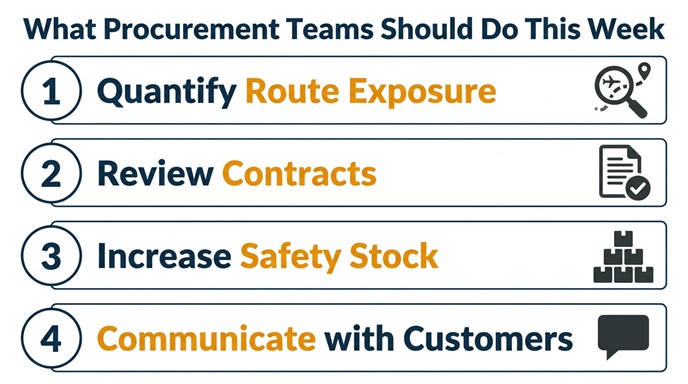
What procurement teams should do this week
Action 1: Quantify your route exposure
Know which ports, which shipping routes, which materials. Understanding your specific exposure determines your vulnerability and mitigation options.
Action 2: Review all supplier contracts and work to minimize force majeure impacts
Regardless of geography, verify your contracts and work with suppliers on reasonable compromises due to wartime implications. DLA Piper legal analysis notes that post-2020 supply agreements increasingly distinguish between “inability to perform” vs. “economic hardship”—critical when suppliers face higher costs without actual supply loss.
Action 3: Increase safety stocks
Now is not the time to play just-in-time. You need to have a just-in-case mentality.
Action 4: Communicate with customers proactively
Brief them now: “Here’s what’s happening, here’s our exposure, here’s our mitigation plan, here’s the likely cost impact.” Converters who demonstrate control keep customers.
What procurement teams should do later
Action 1: Review how suppliers performed
Did they act proactively on supply and prices? Did they notify you and be transparent? Did they have a good disaster plan in effect?
The time to evaluate your supply relationship is during difficult periods. Everyone has plenty of friends when conditions are soft and capacity is abundant. True friends show up in hard times.
Action 2: Review your current risk diversification plan
In the last 5 years there have been at least three major disruptions and all affected global markets—COVID, container shortages, Middle East violence.
Do you spread your supply around? Also, domestic suppliers are not immune to these problems. Eventually pricing and supply issues will arise like we are seeing now.
Action 3: Increase your safety stocks
Gone are the days of just-in-time. So many companies have been left short by not providing ample safety stock to work around supply problems.
Three to four months of stocks cost a little more and impact working capital, but it’s better than running out of material and losing business to your competition who is better prepared.
👉 Now Plastics maintains a vast global array of vetted, quality suppliers of plastic films, aluminum foil, certain resins, and now paper as well. Our customers who have taken the above advice of creating multiple sources from different regions, along with our safety stock programs, are going through substantially less pain at this time and are able to react quickly to take advantage of their competitors running out of material—and to manage their business in a less chaotic manner. Contact us.
Analysis of current Iran-USA/Israel conflict impact on flexible packaging procurement. For integrated resilience strategies, see our 6-part series on tariff monitoring, adaptive procurement, contract structures, geographic diversification, and material substitution.