EPR Compliance for Procurement: The 2026 Playbook for Flexible Packaging
Published on April 29, 2026
Your customer just emailed: “All packaging must be recyclable when EPR requirements take effect. Confirm compliance or we’re rebidding.”
You have limited time to source materials that meet multiple state EPR definitions of “recyclable,” qualify suppliers who can provide certification, and absorb a 12-18% cost premium—while your current multi-layer structures technically work fine.
Welcome to Extended Producer Responsibility. The regulatory momentum is building. Your procurement strategy needs to be ahead of it.
What EPR actually means for procurement teams
Extended Producer Responsibility sounds like a marketing problem. It’s not. It’s a material specification change that procurement owns.
Seven states now require producers to fund recycling infrastructure for packaging: California, Colorado, Oregon, Maine, Minnesota, Illinois, and Vermont. Product Stewardship Institute tracking shows another 12 states with active EPR legislation under consideration.
What this means in procurement terms:
Your customer pays fees based on packaging “recyclability.” Non-recyclable packaging = higher fees. High enough fees = customer demands you switch materials or lose you as a supplier.
The material specification problem
Current reality: Your snack food packaging is PET/Metallized/LLDPE. Excellent barrier properties. Cost-effective. Not recyclable under EPR definitions.
Why: Mixed material structures (PET + PE, BOPP + PE, Metallized + anything) cannot be separated in standard recycling streams. Recyclers need mono-material structures: all-PE or all-PP.
Association of Plastic Recyclers guidelines specify flexible packaging is “recyclable” only when: (1) made from single polymer family, (2) free of barrier coatings that prevent processing, (3) accepted by 60%+ of US recycling programs.
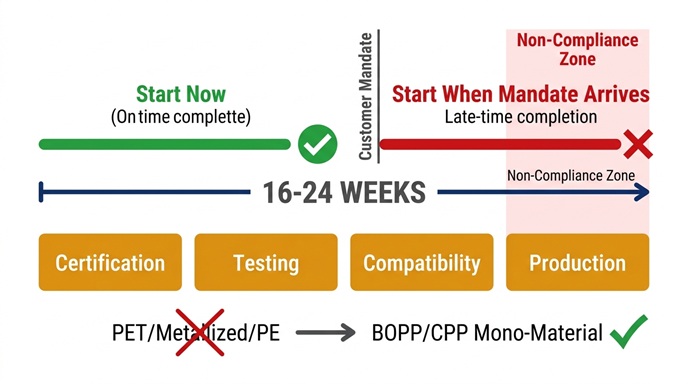
The procurement translation: Replace PET/Metallized/PE → BOPP/CPP mono-material structures where performance allows.
Material alternatives: What actually works
BOPP/CPP Mono-Material Structures (All-Polypropylene)
When it works: Dry snacks (shelf life <6 months), confectionery, bakery products, non-perishable goods with moderate barrier requirements.
What you gain: EPR-compliant recyclable structure, meets How2Recycle program “Widely Recyclable” criteria.
What you lose: Lower oxygen/moisture barrier than metallized alternatives. Cost premium: 12-18% vs. current structures.
Geographic sourcing: China BOPP/CPP (established capacity), Pakistan (quality alternatives), Indonesia/Thailand (growing capacity), Turkey (strong in recyclable PP, Mediterranean routes).
All-PE Structures (Polyethylene)
When it works: Fresh produce, frozen foods, high-moisture applications.
Geographic sourcing: Indonesia/Thailand PE films, Korea PE (premium quality), China PE (volume capacity).
What you cannot make recyclable:
Retort pouches: Sterilization requires multi-layer barrier films. No mono-material alternative exists.
High-barrier applications: Products requiring oxygen transmission <0.5 cc/100 sq in/day need metallized films or EVOH. Mono-material structures don’t achieve this.
These get EPR exemptions. Your job: document why alternatives don’t work.
Supplier qualification: Beyond just material type
Saying “it’s recyclable” doesn’t make it compliant. You need documentation.
What procurement needs from suppliers:
- Material certification (polymer composition, additives disclosure)
- Recyclability certification (How2Recycle eligibility, APR Design Guide compliance)
- Third-party testing (recycler compatibility, sortation verification)
The qualification timeline: 16-24 weeks
Phase 1: Supplier certifications (4-6 weeks)
Phase 2: Customer performance testing (6-8 weeks)
Phase 3: Recycler compatibility testing (4-8 weeks)
Phase 4: Production trial (2-2 weeks)
This is why you can’t wait until mandates arrive to start. If your customer gives you 90-120 days notice and you begin qualification then, you’re already 8-16 weeks late.
The cost reality: EPR isn’t free
Material cost premium: 12-18% typical
Example for 500,000 lbs annual volume:
- Current PET/Metallized/PE: $1.55/lb = $775,000 annually
- BOPP/CPP mono-material: $1.78/lb = $890,000 annually
- Net increase: $115,000 per year
Compare to customer response if you don’t comply:
California EPR fees for non-recyclable packaging: estimated $0.03-0.08/lb based on CalRecycle framework. On 500,000 lbs, that’s $15,000-40,000 annually your customer pays.
Most customers won’t absorb this indefinitely. They’ll demand you switch materials or they’ll switch converters.
Geographic sourcing strategy for sustainable materials
Leaders in recyclable film production:
China: Largest volume capacity for BOPP/CPP mono-material structures. Strong in virgin and post-consumer recycled (PCR) content options.
Korea: Premium quality recyclable films. Higher cost but excellent consistency and technical support.
Turkey: Growing sustainable packaging focus for European market. Mediterranean shipping advantage. Competitive all-PP structures.
Indonesia/Thailand: Expanding recyclable PE and PP capacity. Pacific shipping routes. Cost-competitive.
Certification differences: European suppliers (Turkey, Portugal) often have more established recyclability certifications due to EU regulations predating US EPR. Asian suppliers rapidly developing certifications for US market demand.
What procurement teams should do now
Immediate actions:
- Inventory current materials by application—which are EPR-compliant today?
- Identify customers’ EPR exposure and anticipated timelines
- Begin supplier qualification for mono-material alternatives (16-24 week timeline)
Next 6-12 months:
- Run customer trials with recyclable alternatives
- Lock in pricing before demand surge creates allocation pressure
- Document applications where recyclable alternatives don’t work
Before customer mandates arrive:
- Complete conversions for customers requiring EPR compliance
- Build safety stock of recyclable materials
The distributor advantage on EPR compliance
Solo converters qualifying sustainable materials:
- Research recyclable alternatives across multiple suppliers
- Manage certification documentation from each source
- Navigate different regional standards
- Absorb cost of failed qualification attempts
Distributors with global networks:
- Pre-qualified recyclable BOPP/CPP/PE structures from China, Korea, Turkey, Indonesia, Thailand
- Centralized certification management
- Material alternatives already tested and documented
- Volume aggregation maintains competitive pricing
When your customer demands EPR compliance with 90-day notice, pre-qualified alternatives activate in 4-6 weeks instead of 16-24 weeks.
👉 Now Plastics maintains pre-qualified recyclable mono-material structures across BOPP/CPP and PE families from multiple geographic sources. Our suppliers in China, Korea, Turkey, Indonesia, and Thailand provide EPR-compliant alternatives with established certifications and recycler compatibility testing already complete. When your customer mandates sustainable packaging, we activate alternatives in 4-6 weeks instead of 16-24 weeks—because the qualification work is already done. Contact us.
Procurement perspective on EPR compliance for flexible packaging converters. For supply chain resilience strategies, see our series on tariff monitoring, adaptive procurement, contract structures, geographic diversification, and material substitution.