Domestic + Global: Why the Best Supply Strategy Uses Both
Published on July 7, 2026
Your CEO just asked: “Should we nearshore to Mexico or stick with Asia? Which is the better strategy?”
The wrong answer is picking one.
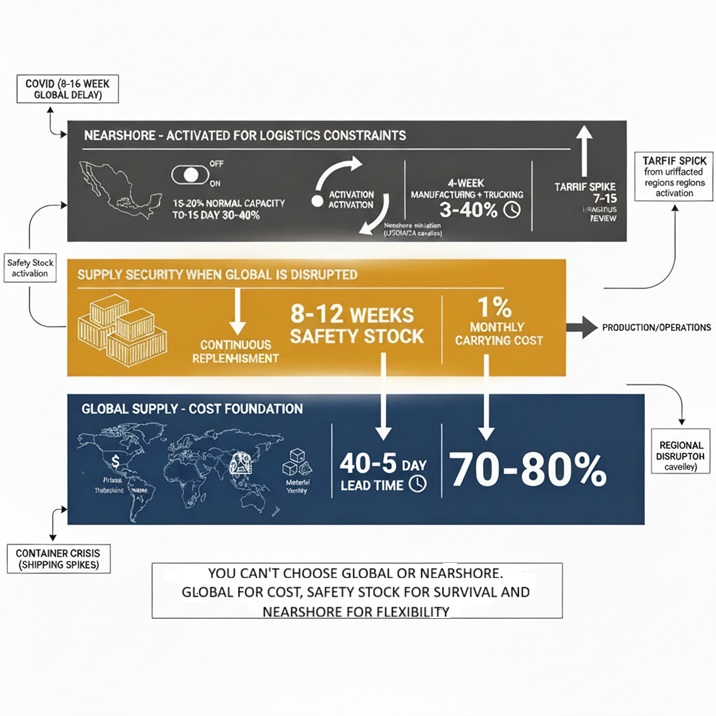
The converters winning in 2020-2026 integrated three elements: global sourcing for cost, local safety stock for security, selective nearshore for flexibility. They didn’t choose between them.
The best supply strategy is: global sourcing for cost + local safety stock for protection + selective nearshore for tariff/geopolitical flexibility.
The 2020-2026 reality: Why global supply needs local buffer stock
2020-2021 (COVID): Asian producers shut down 8-16 weeks. Converters with 8-12 weeks of local safety stock kept producing. Those on just-in-time inventory shut down.
2022 (Container crisis): Shipping costs spiked to record levels. Global lead times extended. Converters with 10-12 weeks warehoused inventory bypassed the crisis. Others faced production gaps.
2025 (IEEPA tariffs): Tariffs hit global sourcing. Converters with 6-8 weeks local safety stock maintained margin continuity while policy clarified. Without it, immediate pricing pressure.
2026 (Hormuz closure): Specific regions disrupted. Converters with 8-10 weeks of local safety stock from unaffected regions maintained production. Others faced 6+ week delays.
Pattern: Every disruption 2020-2026 required local buffer stock. Global supply provides cost. Local safety stock provides continuity when global supply is disrupted.
The integrated supply model
Three integrated layers:
Primary: Global sourcing for cost (70-80% of volume)
- China, Pakistan, Indonesia, Thailand, Europe
- Cost-competitive baseline, volume capacity, material variety
- 40-55 day lead time typical
Critical: Local safety stock (8-12 weeks) held nearby
- Your warehouse OR through logistics partners like Now Plastics
- Continuously replenished from global supply during normal operations
- Protects against shipping delays, manufacturing shutdowns, tariff changes, geopolitical disruptions
- Cost: Carrying cost (~1% per month, or 3% for 3-month safety stock), paid back by avoiding one supply disruption
- Advantage: When global is disrupted, you continue producing from local inventory
Secondary: Nearshore/domestic (15-20% normally, activated 30-40% when needed)
- Mexico BOPP/PE, US Gulf Coast materials (note: USMCA status under annual review with potential changes)
- 4-week manufacturing lead time + 7-15 day trucking (costs 2-3x higher per unit than container shipping in normal conditions)
- Activated when ocean shipping is constrained or when container costs spike; less valuable as default due to cost and USMCA uncertainty
- Provides logistics flexibility when global supply faces constraints, but tariff advantage uncertain
Scenario-based activation:
Tariff spike: Draw down global-sourced local safety stock while cost-effective. Note: Nearshore tariff advantage (USMCA) is uncertain given ongoing annual review and potential renegotiation. Use 8-12 week safety stock as primary buffer while policy clarifies.
Shipping constraint (containers expensive, lead times extend): Activate local safety stock while logistics normalize. Nearshore becomes valuable here—trucking costs are high per unit, but when container shipping costs spike 300-400%, trucking from Mexico becomes economically viable compared to ocean freight.
Regional disruption (specific global region disrupted): Use local safety stock from unaffected regions. Nearshore covers immediate needs while alternative global suppliers qualify.
Managing local safety stock
Location: Your warehouse, third-party provider (like Now Plastics), or hybrid (4-6 weeks each = 8-12 total)
Cost math: Global sourcing is 15-25% cheaper. Safety stock costs ~1% monthly—3% for 3-month stock. One avoided disruption (per Logistics Management, $30K-100K+ cost) pays for 2-3 years of carrying costs.
Supplier relationships: All three are essential
Global suppliers: Primary volume (70-80%). Cost-driven. Define your margin structure.
Logistics partners: Hold safety stock. Pay premium for warehousing/insurance.
Nearshore suppliers: Activated when ocean shipping constrained. Pay premium for logistics flexibility.
2026-2027 action priorities
1. Define optimal safety stock (8-12 weeks typical). Model carrying cost (~1% monthly) vs disruption cost.
2. Decide location—your warehouse, third-party provider, or hybrid?
3. Plan continuous global supplier orders to replenish safety stock.
4. Pre-qualify nearshore before you need it—but don’t count on tariff advantage given USMCA review.
👉 provides cost-competitive global supply across Asia, Europe, and Turkey, PLUS maintain strategic safety stock warehoused across North America. This lets you optimize around global cost while maintaining supply security through local buffer stock. Global supply for cost. Local safety stock for protection against disruption. Selective nearshore for logistics flexibility when ocean shipping is constrained. This is the integrated model the best converters execute. Contact us.
Integrated supply strategy for US flexible packaging converters. For additional resilience strategies, see our series on tariff monitoring, geographic diversification, safety stock strategy, and material substitution.