Material Substitution When Tariffs Force Your Hand
Published on March 24, 2026
When tariffs jumped China BOPP costs 35% overnight, one converter faced a choice: pass the increase to customers and lose business, or find an alternative substrate that performs comparably at lower landed cost.
They switched to CPP from Vietnam for select applications. Customer approval took 90 days. Final result: 18% cost reduction with equivalent performance.
Material substitution isn’t plan A. It’s what you do when tariffs eliminate your first choice.
When substitution makes sense
Don’t switch materials to save 3%. The qualification effort isn’t worth it. Substitute when:
Landed cost differential exceeds 15-20%
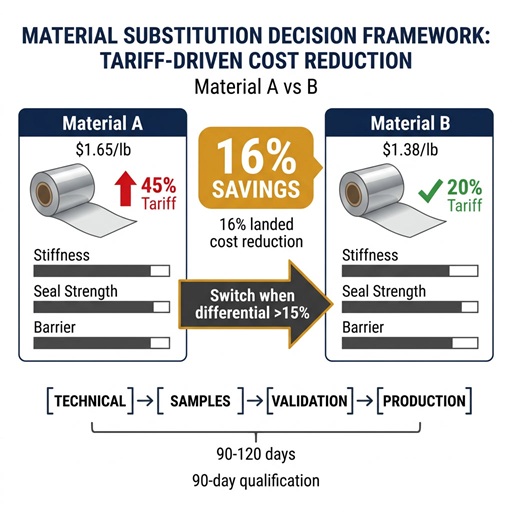
Example: China BOPP tariffs push landed cost to $1.65/lb. Vietnam CPP alternative: $1.38/lb. Differential: 16%. Worth exploring.
Primary material becomes unavailable
Supplier shutdowns, Section 232 exclusions expire, geopolitical disruptions, tariff rate changes
Customer mandates material change
Sustainability requirements (mono-material PP structures for recyclability), regulatory changes, brand specifications
According to CPG packaging research, brands are prioritizing recyclable mono-material structures, driving converters to evaluate BOPP/CPP combinations that simplify end-of-life processing.
Common substitution scenarios
China BOPP (45% tariff) → Vietnam CPP (20% tariff)
When it works:
Applications where BOPP’s stiffness isn’t critical. CPP excels in pillow packs, lidding, fresh produce, bakery overwrap.
The tariff arbitrage:
- China BOPP: $1.05 base + 45% tariff + freight = $1.65/lb
- Vietnam CPP: $1.10 base + 20% tariff + freight = $1.38/lb
- Net savings: 16% by switching both material AND geography
Performance tradeoffs:
- Lose: Stiffness, high-speed printability
- Gain: Superior heat-seal performance, better puncture resistance, lower sealing temperatures
Customer approval timeline: 60-90 days for non-food-contact; 90-120 days with FDA food-contact verification
India BOPP/Metallized → Vietnam BOPP/CPP
When it works:
Dry snacks, confectionery where barrier requirements are moderate
Structure change:
Replace PET/Metallized/PE with BOPP/CPP mono-material for improved recyclability
Geographic + material switch:
- Lower tariff rate (India 50% → Vietnam 20%)
- Simpler structure (easier recyclability)
- Maintains performance for shelf life <6 months
Customer testing required: Accelerated shelf-life studies, migration testing
Cross-region PE → PP substitution
Driver: CPG brands demanding recyclable packaging; PP recycle streams more established than mixed PE/PP
Geographic consideration: Mexico PE (0% USMCA) vs. Asia PP (20-50% tariff) vs. performance requirements
Solution: BOPP outer/CPP sealant = mono-material recyclable structure, sourced from region with most favorable tariff treatment
The customer approval process
Reality check: You can’t just switch. Your customer’s brand is on the package. They control the approval process.
Phase 1 – Technical evaluation (2-3 weeks):
Submit new material specs, barrier data, FDA compliance documentation. Customer compares to current approved material.
Phase 2 – Sample production (3-4 weeks):
Run trial on your equipment with new substrate. Submit samples to customer for evaluation. They test: seal integrity, optical properties, compatibility with their filling equipment.
Phase 3 – Shelf-life validation (4-12 weeks):
Accelerated aging studies for food contact. Real-time shelf-life testing for perishables. This phase determines timeline—cannot be rushed.
Phase 4 – Production trial (2-3 weeks):
Customer approves commercial production run. Monitor first 3-6 months for performance consistency.
Total: 11-22 weeks depending on application complexity and customer requirements.
Distributor advantage: Pre-qualified alternative materials across multiple substrates AND multiple geographies. When China BOPP tariffs spike, we activate Vietnam CPP alternatives already approved and ready to scale—combining material AND geographic flexibility in one move.
Cost-performance calculation
Don’t evaluate substitution on material cost alone. Model total impact:
Current structure (China BOPP 45% tariff):
- Material: $1.65/lb landed
- Yield: 95% (waste/scrap)
- Customer complaints: <0.5%
Alternative (Vietnam CPP 20% tariff):
- Material: $1.38/lb landed (16% savings)
- Yield: 92% (softer film = more handling waste)
- Rework risk during qualification: 2-5% of production
Net savings year 1: 8-10% after accounting for qualification costs, yield differences, rework
Payback period: 6-9 months on high-volume applications
Hidden benefit: Tariff exposure reduction through geographic + material diversification
What you can’t substitute
Some applications have zero substitution flexibility:
Retort pouches: Material must withstand 250°F sterilization. Limited alternatives to PET/Foil/CPP or Nylon/Foil/CPP structures.
High-barrier applications: Oxygen transmission <0.5 cc/100 sq in/day requires metallized films or EVOH. Cost-effective alternatives don’t exist.
Customer-approved specifications: Many CPG brands have locked material specs in co-packer agreements. Substitution requires contract renegotiation regardless of economics.
2026 substitution priorities
1. Map tariff-vulnerable materials now
Identify which substrates face highest tariff exposure by country. Model alternative materials from lower-tariff regions before crisis hits.
2. Pre-qualify alternatives with key customers
Don’t wait for 35% tariff increase. Get approval for alternative materials (Vietnam CPP, India PE, Mexico structures) during stable periods when you have negotiating time.
3. Sustainability-driven substitutions
Extended Producer Responsibility laws in seven states create compliance deadlines. Mono-material structures aren’t optional—they’re required.
Next: Series conclusion—integrating tariff resilience, geographic diversification, contract structures, and material flexibility into a unified procurement strategy.
👉 Now Plastics maintains pre-qualified alternative materials across BOPP, CPP, PE, and PET families from multiple geographic sources. When China tariffs make your current BOPP substrate uneconomical, we activate Vietnam or India alternatives already approved for similar applications—cutting your qualification timeline from 120 days to 30 while optimizing both material performance AND tariff exposure. Contact us.