New website launch!
Is your procurement strategy built for a 2024 world or a 2026 reality?
Published on May 12, 2026
Is your procurement strategy built for a 2024 world or a 2026 reality?
Static, annual RFQs failed in 2025 when “Liberation Day” reciprocal tariffs and Section 232 spikes doubled costs for materials like aluminum foil overnight. In this volatile environment, “planning” isn’t enough—you need Adaptive Procurement infrastructure that pivots automatically.
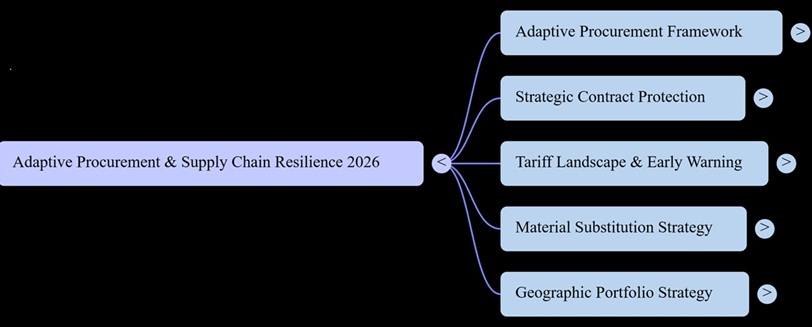
Our latest Procurement Mindmap breaks down the framework used by industry leaders to maintain resilience:
- The Three-Region Minimum Rule: Stop relying on a single source. True resilience requires maintaining a 60/30/10 volume split across primary, secondary, and “warm” tertiary regions. This will allow you to always be ready to shift when landed costs fluctuate.
- Strategic Contract Protection: Move away from rigid contracts to Master Service Agreements (MSAs). Ensure your agreements include bidirectional price escalation and index-based pricing to capture savings immediately. Especially when tariffs or commodity costs drop.
- The Auto-Pivot Trigger: Don’t wait for a crisis to react. Set automated triggers—like a 15% cost increase—to immediately shift volume to pre-qualified secondary suppliers.
- Material Substitution as a Strategic Lever: When tariffs on a specific substrate (like China-sourced BOPP) exceed 15-20%, having a pre-qualified alternative (like Vietnam-sourced CPP) can save your margins.
- The Distributor Advantage: While individual qualification can take 120 days, leveraging a distributor’s global network can reduce your pivot timeline to just 30–60 days.
With the USMCA review and the China tariff framework expiration looming in late 2026, the time to build your “auto-pivot” supply chain is now.