Building Procurement Resilience: When Everything Hits at Once
Published on April 8, 2026
When Iran-US/Israel tensions escalated in March 2025, one converter lost their primary BOPP supplier in 72 hours. Shipping through the Strait of Hormuz stopped. Tariffs on backup suppliers jumped 40%. Customer orders kept coming.
They had no backup plan. 16 weeks to find, qualify, and activate alternatives. $340K in emergency airfreight costs. Three customers lost to competitors.
Another converter faced the same crisis. Their response time: 11 days. Cost impact: 8% margin compression instead of complete shutdown.
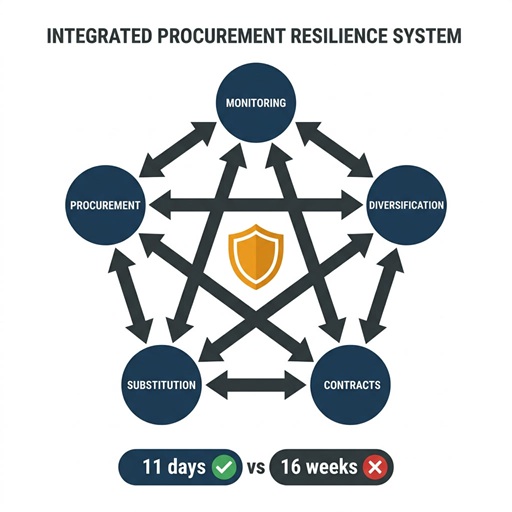
The difference wasn’t luck. It was having all five strategies working together before the crisis hit.
Why individual strategies fail under compound pressure
You can’t early-warning-system your way out of a geopolitical shutdown. You can’t geographic-diversify when multiple regions face simultaneous disruptions. You can’t contract-negotiate your way around materials that simply don’t exist.
Procurement resilience isn’t one strategy. It’s five strategies functioning as a system.
According to McKinsey supply chain research, companies with integrated risk management approaches recovered 40% faster from disruptions than those relying on single-point solutions.
March 2025 tested this brutally. Iran-Israel conflict closed Red Sea shipping lanes. China imposed new export controls. Vietnam raised tariffs on select polymer exports. India experienced power grid failures affecting production.
Four separate disruptions. Different causes. Same effect: converters scrambling.
How the five strategies integrate
Strategy 1 (Tariff early warning) catches the signal
Daily monitoring flags Iran tensions escalating, shipping insurance rates spiking 300%. You see this 10 days before mainstream news coverage.
Strategy 2 (Adaptive procurement) activates alternatives
Pre-qualified Vietnam supplier already in your system. You reallocate 60% of volume in 48 hours while competitors read headlines.
Strategy 3 (Contract structures) protect against cost spikes
Geopolitical force majeure clauses with automatic reallocation provisions. Supplier can’t impose 40% emergency surcharges—you shift to Contract B with pre-agreed pricing.
Strategy 4 (Geographic diversification) provides depth
Vietnam uses Pacific routes. India backup uses different ports. Mexico USMCA materials sidestep the entire issue. Maritime Executive reporting shows Red Sea disruptions added 15-20 days to Europe-Asia shipping, but Pacific routes maintained 90% on-time performance.
Strategy 5 (Material substitution) handles the unplannable
When India power failures cut metallized BOPP supply, pre-qualified CPP alternatives from Vietnam activate. Customer approval already exists. Lead time: 2 weeks instead of 16.
None of these strategies works alone. Early warning without pre-qualified alternatives = knowing disaster is coming but unable to act. Geographic diversification without contract protection = suppliers gouging you during crisis. Material substitution without adaptive procurement = 120-day qualification timelines that miss the window.
Real case study: Integrated response vs. fragmented response
Converter A (integrated approach):
- Day 1: Tariff monitoring flags Iran shipping disruption risk
- Day 3: Team reviews pre-qualified Vietnam and Mexico alternatives
- Day 5: Activates contract reallocation clauses with Supplier B (Vietnam)
- Day 8: First shipment redirected through Pacific route
- Day 11: 60% of volume reallocated; material substitution initiated for affected SKUs
- Total disruption cost: 8% margin compression, zero customer losses
Converter B (fragmented approach):
- Day 1-7: Unaware of escalating risk until supplier force majeure notification
- Day 8-14: Emergency sourcing team formed; realizes no pre-qualified alternatives exist
- Day 15-30: Rushing qualification samples to customers while paying 300% shipping premiums
- Day 31-112: Waiting for customer approvals, negotiating emergency contracts at disadvantaged pricing
- Total disruption cost: 16 weeks partial shutdown, $340K airfreight, 3 customers lost, 31% margin erosion
According to Deloitte’s resilience benchmarking, companies with integrated multi-strategy resilience frameworks experienced 60% lower recovery costs during the 2024-2025 disruption period.
The cost of fragmentation
Most converters have pieces of this system:
- 40% monitor tariffs but don’t connect to procurement action
- 65% have backup suppliers but haven’t qualified materials
- 50% have geographic diversity but no contract mechanisms to activate quickly
- 30% have material substitution capability but no pre-approvals
Having the parts doesn’t mean you have the system.
The integration failures that kill resilience: early warning exists but procurement team doesn’t see alerts; alternative suppliers identified but contracts don’t include reallocation triggers; material alternatives researched but customer pre-approvals never obtained; geographic diversity planned but no tested activation procedures.
Each gap adds 2-6 weeks to response time. Three gaps = procurement paralysis.
2026 priorities: Building integrated resilience
Connect monitoring to action. If tariff alerts don’t automatically trigger procurement review meetings, you have an information system, not a resilience system. Build the workflow: alert → assessment → decision → activation.
Pre-qualify everything you might need. Don’t research alternatives during crisis. Qualify them now: Vietnam CPP, India PE, Mexico structures, alternative shipping routes, backup contract terms. The qualification timeline is 90-120 days—do it before you need it.
Test your integration annually. Run tabletop exercises: “China BOPP tariffs jump 50% tomorrow—walk through the response.” Find the gaps when they don’t cost real money.
Build the financial model. Calculate what a 16-week disruption costs vs. maintaining pre-qualified alternatives. The math isn’t subtle: Converter B spent $340K on one crisis. Pre-qualification costs: $15K-25K annually.
Document activation procedures. When Iran tensions spiked, Converter A executed a documented playbook. Converter B had a strategy deck from 2023. Documentation isn’t bureaucracy—it’s the difference between 11 days and 16 weeks.
What 2026 brings
Geopolitical volatility isn’t decreasing. Regional trade conflicts and supply chain fragmentation will intensify through 2026-2027. Tariffs remain the primary tool. Shipping route disruptions will recur.
EPR compliance deadlines hit in seven states. Material substitution isn’t optional anymore—it’s regulatory.
Customer consolidation accelerates. Major CPG brands are cutting converter rosters 30-40%. The ones who survive are the ones who didn’t go dark during the March 2025 disruptions.
Your competitors are building these systems. The question isn’t whether you need integrated procurement resilience. It’s whether you’ll build it before or after the next crisis proves you don’t have it.
👉 Now Plastics maintains the integrated infrastructure most converters lack: real-time tariff monitoring across 60+ global suppliers, pre-qualified materials across BOPP/CPP/PE/PET families from multiple geographies, contract structures with automatic reallocation triggers, and tested activation procedures. When Iran-Israel tensions disrupted Red Sea shipping in March 2025, our customers reallocated volume to Pacific-route suppliers in 48-72 hours—not 16 weeks—because the alternatives were already qualified, contracted, and operational. This is the difference between integrated resilience and fragmented hope. Contact us.