Contract Negotiation in Volatile Markets: How Buying Power Protects Converters
Published on March 12, 2026
Contract Negotiation in Volatile Markets: How Buying Power Protects Converters
When Section 232 tariffs doubled overnight on June 4, 2025, most converters scrambled to renegotiate existing contracts. Those working through multi-region distributors? Their contracts already included tariff adjustment mechanisms that activated automatically.
The difference wasn’t luck—it was contract architecture negotiated before volatility hit.
Why individual converters can’t negotiate what distributors can?
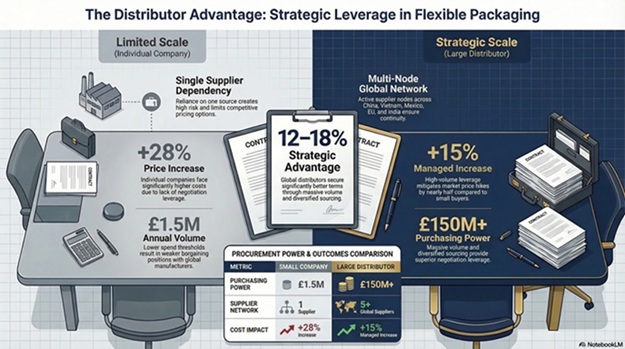
A mid-sized converter buying $0.5-1 M annually from a Chinese BOPP supplier has limited leverage when tariffs jump 20% overnight. That same converter, as part of a distributor network representing $100M in annual purchases across 60+ suppliers, gains advantages no individual buyer can replicate.
Three leverage points:
Volume aggregation: Strategic relationships get first allocation during shortages, priority pricing during volatile periods, and flexible payment terms.
Geographic optionality: A converter sourcing 100% from China or any other single specific country has one position: accept the increase or find a new supplier (6-12 months to qualify). A distributor with qualified suppliers in Vietnam, India, Mexico, and Europe has five positions simultaneously.
Information asymmetry reduction: Individual converters don’t know if their supplier’s 18% increase reflects actual cost pass-through or opportunistic margin expansion. Distributors seeing pricing across dozens of suppliers know immediately.
According to Foley & Lardner’s import risk research, companies with strong tariff allocation clauses avoided the disputes that plagued others in 2025.
Essential contract clauses
- Material price escalation clauses
Standard framework:
“Prices subject to adjustment if landed cost increases by more than [5%] in any [60]-day period due to tariffs, commodity movements, or FX. Adjustments require documented evidence from supplier invoices, published indices, or official tariff changes.”
Converter-favorable additions:
– Bidirectional: “Price decreases require downward adjustment”
– Verification: “Supplier provides documentation within 15 days”
– Cap: “Total adjustments shall not exceed [15%] in any 12-month period”
Why distributors negotiate better: Individual converters get unilateral escalation (supplier raises, buyer can’t force decreases). Distributors negotiate bidirectional clauses with verification requirements.
- Tariff pass-through mechanisms
Formula approach:
Price = Base Price + (Tariff Rate × Material Cost) + Freight + Handling
Example:
– Base BOPP: $1.20/lb
– Material cost component: $0.90/lb
– China tariff increases 25% to 45% (20-point increase)
– Tariff impact: $0.90 × 0.20 = $0.18/lb
– New price: $1.38/lb
This removes ambiguity. Everyone calculates the same number.
Converter protection: “Tariff decreases result in equivalent price reductions within 30 days.”
- Index-based pricing
Tie prices to published indices both parties can verify.
For resins: Plastics News, ICIS
For aluminum: London Metal Exchange
Formula:
Price = [Index Value × Factor] + Processing Fee + Freight + Tariffs
Why this matters: Supplier says “costs up 22%.” Index shows 8%. Distributor pushes back with data. Individual converter without index access accepts 22%.
- Volume commitment with allocation flexibility
Distributor advantage:
“Buyer commits to [X] tons annually across Distributor’s qualified supplier network. Distributor allocates volume based on competitive landed cost, quality, delivery. Buyer reserves right to request specific supplier with 90-day notice.”
Benefit: Volume pricing without single-source risk. If China tariffs make Chinese BOPP uncompetitive, your distributor shifts to Vietnam or Mexico automatically—no renegotiation required.
- Reopener clauses
Triggering events:
– Tariff changes exceeding 15 percentage points
– Force majeure events
– New regulatory requirements
Process:
“Either party may invoke with written notice. Parties negotiate in good faith for 45 days. If no agreement: [buyer may source elsewhere without penalty / prices revert to baseline].”
Critical: Define what happens if renegotiation fails.
Real-world performance: 2025
Aluminum foil (June 2025):
Converter A (direct):
– Fixed price contract
– Supplier demands 35% increase after tariffs double
– Result: Accepted 28% after negotiation, production delays
Converter B (via distributor):
– Index-based with tariff formula
– Distributor: “Per tariff pass-through, prices increase 22%. Activating EU supplier to limit your blended increase to 15%.”
– Result: 15% vs. 28%, zero disruption
BOPP from Vietnam (Q3 2025):
Converter C (direct):
– Annual fixed price
– Vietnam rate drops from 46% to 20%
– Supplier: “Price locked until January renewal”
– Result: Overpaid 18% for 6 months
Converter D (via distributor):
– Bidirectional clause
– Calculation: $0.85 × 0.26 = $0.22/lb decrease
– Result: Price decrease August 1, $110K savings
What to demand from your supplier
Five critical questions:
1. “Show me your price escalation clause. Is it bidirectional?”
Good answer: Documented formula with caps and decrease provisions
2. “How are tariff changes calculated?”
Good answer: Mathematical formula with material cost breakdown
3. “What indices do you use for commodity pricing?”
Good answer: Published index with adjustment schedule
4. “What backup suppliers do you have qualified?”
Good answer: Specific countries with pivot timeline and quarterly trial orders
The buying power advantage: Quantified
According to Evergreen Resources, suppliers with flexible global networks are better positioned to respond to volatility.
Distributor vs. individual converter:
Tariff mitigation:
– Individual: Full pass-through (15-25%)
– Distributor: Geographic reallocation (8-12%)
Volume pricing:
– $2M annually: Baseline + 3-5% premium
– $200M annually: Baseline with preferred allocation
Payment terms:
– Individual: Net 30-45
– Distributor: Net 60-90 with early payment discount
Crisis response:
– Individual: 6-12 months to qualify alternative
– Distributor: 30-60 days pivot to pre-qualified
Total advantage: 12-18% in volatile periods, 5-8% in stable periods
2026 priorities
1. USMCA certification
July 2026 review creates uncertainty. Contracts should specify certificate of origin responsibility and transshipment penalties.
2. Duty drawback provisions
Supreme Court IEEPA ruling could trigger refunds. Address who receives refunds and retroactive adjustments.
3. Sustainability compliance
Seven states have EPR laws. Define responsibility for EPR fees and recycled content surcharges.
Stay tuned to next in this series: Geographic portfolio strategy—how multi-region networks provide built-in resilience.
Now Plastics negotiates on behalf of hundreds of converters, creating leverage individual companies cannot achieve. Our contracts with 60+ global suppliers include tariff formulas, bidirectional clauses, and geographic flexibility that protected customers through 2025’s volatility. Contact us to review how our contract structure compares to yours.