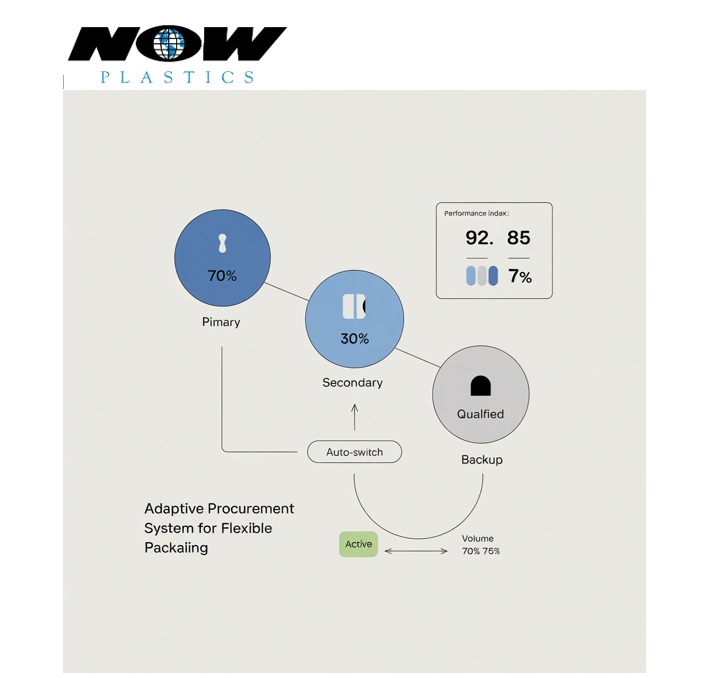
Adaptive Procurement Systems: Auto-Pivot Supply Chains for Flexible Packaging
Published on February 3, 2026
Adaptive Procurement Systems: Auto-Pivot Supply Chains for Flexible Packaging
When aluminum foil tariffs doubled to 50% on June 4, 2025, Hammont Premier Packaging’s costs didn’t spike—they’d qualified European and North American alternatives 18 months earlier. Their procurement system pivoted automatically based on landed cost triggers built into supplier contracts.
Companies without adaptive systems scrambled while production lines sat idle. The difference wasn’t planning—it was infrastructure that pivots automatically when tariff, capacity, or quality triggers activate alternative suppliers.
Why static procurement failed in 2025
Traditional procurement—annual RFQs, single-source awards, 12-month contracts—assumed stable trade policy and predictable freight costs.
Section 232 tariffs doubled same-day (June 4). Liberation Day reciprocal tariffs took effect 3-7 days after announcement. China rates escalated from 34% to 125% in one week.
McKinsey reports 73% of companies made progress with dual-sourcing strategies. But dual sourcing alone isn’t enough—you need automated triggers that activate alternatives before disruptions hit production.
The four-part adaptive framework
Baseline: At least two qualified suppliers for every critical material, plus one partially qualified backup.
Strategic materials (aluminum foil, specialty barriers): Primary + secondary suppliers, both qualified, with 70/30 volume split. Monthly production runs at secondary maintain familiarity.
Commodity materials (PE, BOPP, adhesives): Three suppliers minimum, volume allocated quarterly based on landed-cost benchmarking.
Specialized materials (custom formulations): Primary supplier + backup partially qualified, with quarterly trial runs.
Qualification timeline: 90-120 days
- Days 1-30: Documentation review (ISO certs, financials, FDA/EU MDR compliance)
- Days 15-60: Technical qualification (specs, Cpk studies, barrier testing)
- Days 45-90: Production trials (full volume runs, quality testing)
- Days 75-120: Contract execution with pivot triggers
- Automated cost-tracking
Manual tracking can’t keep pace with daily tariff changes. Real-time landed cost calculators (which accounts for varying exchange rates) integrated with ERP provide decision-ready data.
Data inputs:
- Base costs: Weekly updates with CPI/PPI indexation
- Tariff rates: federalregister.gov and CBP.gov/trade alerts (24-hour updates)
- Freight: Live integration with forwarders
- FX: Daily conversions
Automatic triggers:
- 10% increase (30 days) → Request secondary quotes
- 15% increase or tariff announcement → Shift 50% to secondary
- 25% increase or capacity constraint → Full pivot, initiate tertiary qualification
Platforms: SAP, Oracle, Microsoft Dynamics (enterprise); Graphite Connect, Kodiak Hub (mid-market).
- Contract structures with pivot triggers
Static annual contracts create barriers. Master Service Agreements (MSAs) with all qualified suppliers simultaneously remove barriers.
MSA benefits:
- Legal framework in place with all suppliers
- No renegotiation required to shift volume
- Suppliers compete on performance
- Pivots take days instead of weeks
Critical MSA clauses:
Volume commitment: “Buyer commits to minimum annual volume across qualified suppliers. Individual allocation determined quarterly based on landed cost, quality, capacity. Buyer provides 60-day rolling forecast.”
Tariff adjustment: “Tariff changes >5 percentage points trigger renegotiation within 30 days. If no agreement within 45 days, Buyer may reallocate volume without penalty.”
Index-based pricing – Update monthly with Plastics News, ICIS, or regional indices.
- Performance monitoring
Automated scorecards track quality (35%), delivery (30%), cost (20%), responsiveness (15%).
Performance Guarantee Index (PGI):
Converters need a composite scoring system that combines contractual guarantees with real-time performance data to drive volume allocation decisions automatically.
Your 90-day build
Days 1-30:
- Map spend by category/supplier
- Identify single-source vulnerabilities (>80% from one supplier)
- Track landed costs for top 20 materials
- Document current performance
Days 31-60:
- RFI to 3-5 suppliers per category
- Documentation review
- Sample testing
- Draft MSA templates
Days 61-90:
- Production trials
- Quality validation
- MSA execution
- ERP configuration
Real-world results from other industries:
HP: Taiwan/Thailand sourcing expansion = 8% cost reduction. Quarterly benchmarking reallocates based on landed cost.
Apple: $1B+ invested in India/Vietnam supplier development. Automatic routing based on tariff exposure, capacity, quality.
Walmart: 10% Chinese import reduction in 2024 via Southeast Asian/Indian networks. 5% logistics cost increase offset by better tariff positioning.
Deer Stags: $1M inventory stranded when overnight tariffs jumped duties from $60K to $1.5M. No qualified alternatives. Missed back-to-school season.
NAM President Jay Timmons: “25% tariffs threaten supply chains. Ripple effects severe for small manufacturers lacking flexibility and capital to rapidly find alternatives.”
Prioritization matrix
Tier 1 (immediate multi-sourcing):
- Tariff exposure >30%
- Regions with active trade tensions
- 10% of total spend
- Only 1-2 global suppliers
Tier 2 (dual sourcing within 6 months):
- Tariff exposure 15-30%
- Politically volatile regions
- 3-5 global suppliers
Tier 3 (monitor, qualify as capacity allows):
- Tariff exposure <15%
- Stable trade partners
- 5 readily available suppliers
Tools and resources
Supplier qualification:
Contract templates:
Procurement platforms:
- Enterprise: SAP Ariba, Oracle, Coupa
- Mid-market: Kodiak Hub, Graphite Connect, Ivalua
2026 decision points
Three certainties:
- China tariff framework expires Nov 10, 2026 – 10% reciprocal suspension ends
- USMCA review begins Jul 1, 2026 – Rules of origin may tighten
- Supreme Court IEEPA ruling expected early 2026 – Could invalidate or affirm reciprocal tariffs
Adaptive systems position you for either outcome. Tariffs decrease? Maintain relationships and benchmarking. Tariffs increase? Infrastructure activates alternatives automatically.
Part 2 of Now Plastics’ Future-Proofing Series for flexible packaging converters.